

Welcome to Dispatch #86 of The Audio Insurgent.
I had originally written a post that was supposed to come out a few weeks ago…then Apple Podcasts made their video announcement and I needed to re-write the whole thing. Today’s dispatch is all about the podcast conversation du jour.
But first…
[SHORT THING 1 OF 3: WE ARE HIRING] In the context of the main subject of this dispatch, these may be seen as deeply ironic. So be it.
Magnificent Noise needs a part time video editor to join our team. We’ve outgrown our current systems and workflow for the video side of projects and need someone to join us and help mold this role into potentially something bigger.
You can apply at this link.
[SHORT THING 2 OF 3: BIFURCATION OF PURPOSE] If you aren’t subscribing to Ben Robins’ The Sound Insights Report, fix that right now. In a recent post, Ben cuts through one of podcasting’s most tiresome current debates—whether video is “killing” audio—and replaces it with something far more useful. Drawing on new listener data, agency performance reports, and platform trends, Ben argues that podcasting isn’t facing a format war but a bifurcation of purpose. Video is increasingly the discovery engine—the spectacle layer optimized for algorithms, living-room screens, and shareable clips. Audio, meanwhile, remains the conversion engine—the intimate medium where trust is built and action happens. If you care about where podcasting is actually heading (and not just what people on LinkedIn are yelling about), this piece offers a clear framing: video is the front door; audio is the home. It’s a useful way for creators, brands, and platforms to think about what they’re really trying to achieve with podcasting, and how both platforms contribute.
MY POV: Just another point to illustrate that the emergence and rise of video does not necessarily mean the defeat/death/reduction of audio. For many years, I used to tell radio people “You don’t have to hate broadcast to love digital.” I find myself saying the same thing now in the audio vs. video debate, because it really isn’t audio vs audio, it is audio AND video.
Worth a read.
[SHORT THING 3 OF 3: HEARSAY] Many people have heard me wax poetically of the magic of the Hearsay Festival. There hasn’t been one since the pandemic, but I attended three beforehand and every one was amazing.
So I’m happy to report, it is coming back this spring.
If you aren’t aware, it is an audio festival that takes place in the fantastic middle-of-nowhere mountain town of Kilfinane, County Limerick, in Ireland. The festival takes over the town of 700, with festival venues in the front room of the library, the chapel in the local convent, and even people’s homes. And it is all about audio in all its powerful forms. You’ll hear amazing narrative, documentary, audio art, and even a bunch of deliciously weird stuff too. If you really want an immersive and fun way to fall in love again with audio in all its forms, this is the place. I really can’t express how wonderful this is. There are no nametags, the day’s schedule is printed each morning in a shop window, and cell reception sucks there, so get used to being unattached from the outside world. There are two pubs in town, where I basically encamp myself and spend hours meeting and connecting with people. So fun.
And, mostly because it is happening in a tiny town, there is a cap on how many people can attend. So if this sounds appealing to you, you should grab one of the last remaining tickets while you can.
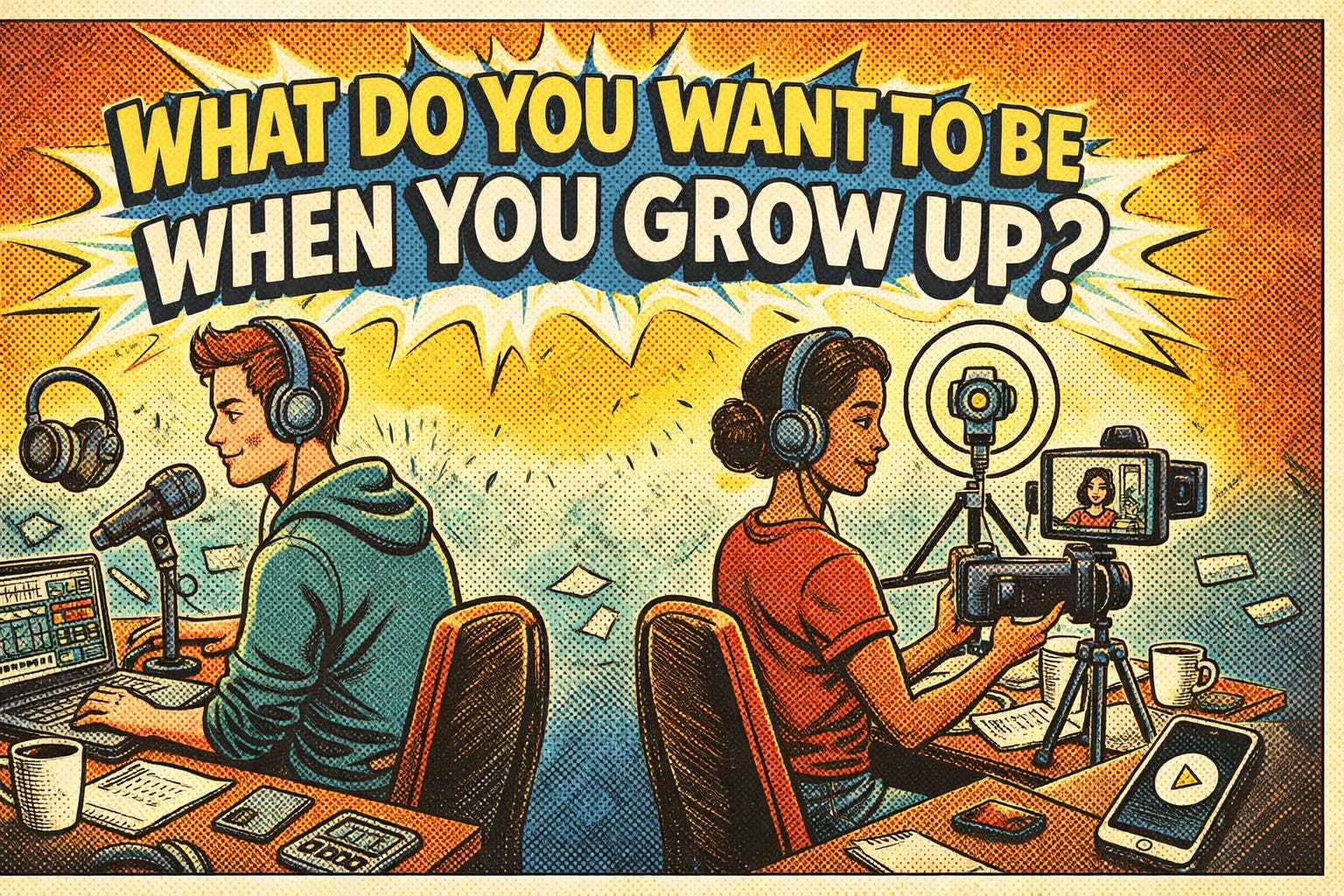
[WHAT DO YOU WANT TO BE WHEN YOU GROW UP?] Something unexpected happened a few weeks ago that made me realize that we’d come to a change point in podcasting. And, no, it wasn’t Apple Podcast’s Presidents Day video announcement. It was the debut of The Atlas Ink Podcast from one of my favorite stationery stores, Chicago’s Atlas Stationers.
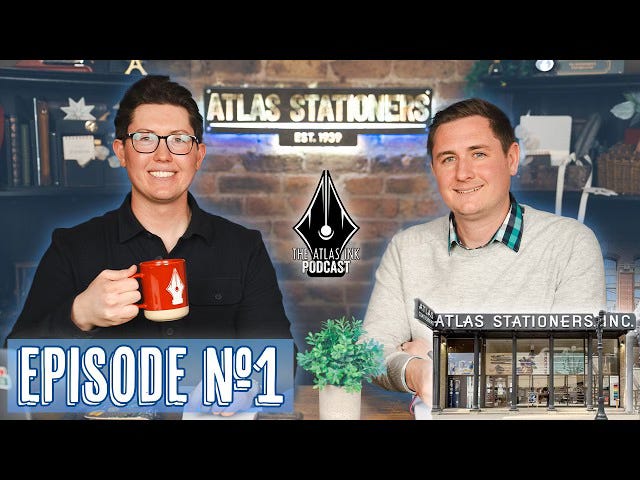
Why was this such a big deal to me? Well, not only was I excited for one additional place to hear talk about fountain pens, but I was really confused as well. The hosts (also Atlas’s owners) were so proud to call what they’d made a “podcast”--yet it was missing most of the trapping that we associate with a podcast…even a video podcast. No mics or headphones, which is how most listeners identify a video podcast as a podcast. But stranger yet, there was no RSS feed…nor was there an audio version of The Atlas Ink Podcast. It was just two people sitting on opposite sides of a table having a fairly stilted and awkward conversation (give them a break, they are new–their hearts are in the right place, though).
I found myself thinking: have we diluted podcasting so much in our rush to expand it that the only thing necessary to call a podcast a podcast is…the act of labeling it as a podcast?
I could feel my mind melting over this one.
To be fair, Atlas Stationers did end up reconciling this about three weeks later–now there is an audio version and an RSS feed. But they set those up on February 24th, 8 days after the Apple announcement–so my mind was melting over other things and I forgot to notice the sudden podcastiness of this mind melting podcast.
While it is safe to say we are now fully in the “Pivot to Video Era” of podcasting’s evolution (which, frankly, is probably going to go as well as every single other media “pivot to video” of the past), I think one of the most interesting, and least discussed, elements of this time is not how the medium is changing, but how that evolution is changing what it means to be a “podcast producer.”
Can you get hired today in podcasting without at least some semblance of video skills? Looking at the job descriptions I see, that would be a challenge.
So what does the video-on-the-brain-ness of this moment mean for our creative workforce? Do you pivot as well, or do you lock and load on increasingly hard-to-find audio-only work? In short…
What do you want to be when you grow up? An audio producer…or a podcast producer?
For a few years, we’ve been able to think these are the same thing, but I think we’ve reached a point where they are no longer the same job. We’ve expanded the definition of a podcast so broadly that the label now precedes the format. And once that happens, the job of making one changes too.
When I think of an audio producer, I think of someone working in an audio-first medium—radio, podcasts, audiobooks—focused on intimacy, narrative, and craft. The work is about what happens in the listener’s head.
A podcast producer, increasingly, is…something else (or, at least…something more). The job spans audio, video, and social platforms. It is as much about packaging, distribution, and growth as it is about making the thing itself.
Spend five minutes looking at podcast job descriptions right now and this becomes obvious. Video isn’t a bonus skill anymore. It’s table stakes.
That shift has real implications, especially for people early in their careers or trying to stay relevant in the middle of one. If you’re coming up in this business now, you’re not really choosing between formats—you’re choosing between skill sets. One path asks you to go deeper: to refine your ear, your storytelling instincts, your sense of pacing and structure. The other asks you to go broader: to think in terms of platforms, formats, and how something moves through an ecosystem. Both are valid. But they reward different things. And increasingly, they are being hired, evaluated, and compensated differently.
As this shift has been unfolding over the past two years, there have been a number of times where various Magnificent Noise employees have grumbled about having to learn video skills. I always respond with “Well, your next job is going to expect you to know these things, so isn’t it great that I’m paying you to learn them now?”
To be honest, that is how I personally have embraced this moment: I’m learning. I find my heart beats faster when I have to figure out things I don’t know (and there are A LOT of things that I don’t know). The emergence of video in podcasting has provided me (and our company) permission to learn, build new skills, and expand what we can offer to clients.
I’ve looked at it much as I view my shadow career as a writer: it is something I love doing that tickles a different part of my brain…and has the benefit of making me better at what I do most of the time.
But that’s the thing about where podcasting is today…it isn’t just a matter of “adding a new skill”--it is about fundamentally changing what the thing is.
But once you get past the change in skill demand, there’s a part of this that I find genuinely encouraging.
Remember what Ben Robins laid out: If video is becoming the front door to podcasting, then audio is still the place people choose to stay. It’s where attention deepens. It’s where trust is built. It’s where the work actually happens.
That hasn’t changed. If anything, THAT is where the real skill lies. And that will become MORE in demand.
So maybe the real question isn’t whether you choose to become an audio producer or a podcast producer. Maybe it’s whether you understand what each of those roles is actually for.
Because in a world where everything can be called a podcast, the people who understand the power of audio—real audio, intentional audio—are only going to become more valuable.
I guess where I’m landing on this is that fewer and fewer people know how to make something that lives in someone’s head. That’s not a limitation. That’s an advantage.
So it might be worth asking yourself—especially if you’re early in your career, or rethinking it midstream: What do you actually want to get good at?
Because those are becoming two very different answers—with two very different skill sets. It is absolutely possible to do both (hell, this is what I’m trying to do). But it’s far more important to understand what those skills are in service of.
If you are in the empathy business…
If you are in the making the world both bigger and smaller business…
If you are in the audience service business…
If you are in the building community and connection business…
If you are in the elevating voices that need to be heard business…
Then yes—the tools are changing. The expectations are changing. The jobs are changing.
But the work itself?
That part hasn’t changed at all. And if you understand that, you’ll know exactly what to get better at.
Okay, that’s it for today.
Thousands of people read this newsletter without even a free subscription. If this was forwarded to you or you read this online, would you mind subscribing?
If you are a regular reader of The Audio Insurgent, I hope you’ll consider doing your part by supporting this work with a small donation. And if that’s too much, you are also always welcome to buy my book or (even better) buy me a beer.
Make great things. I’ll be listening.
--Eric